

Amplifying Community Voices for Locally Led Adaptation in the Caribbean
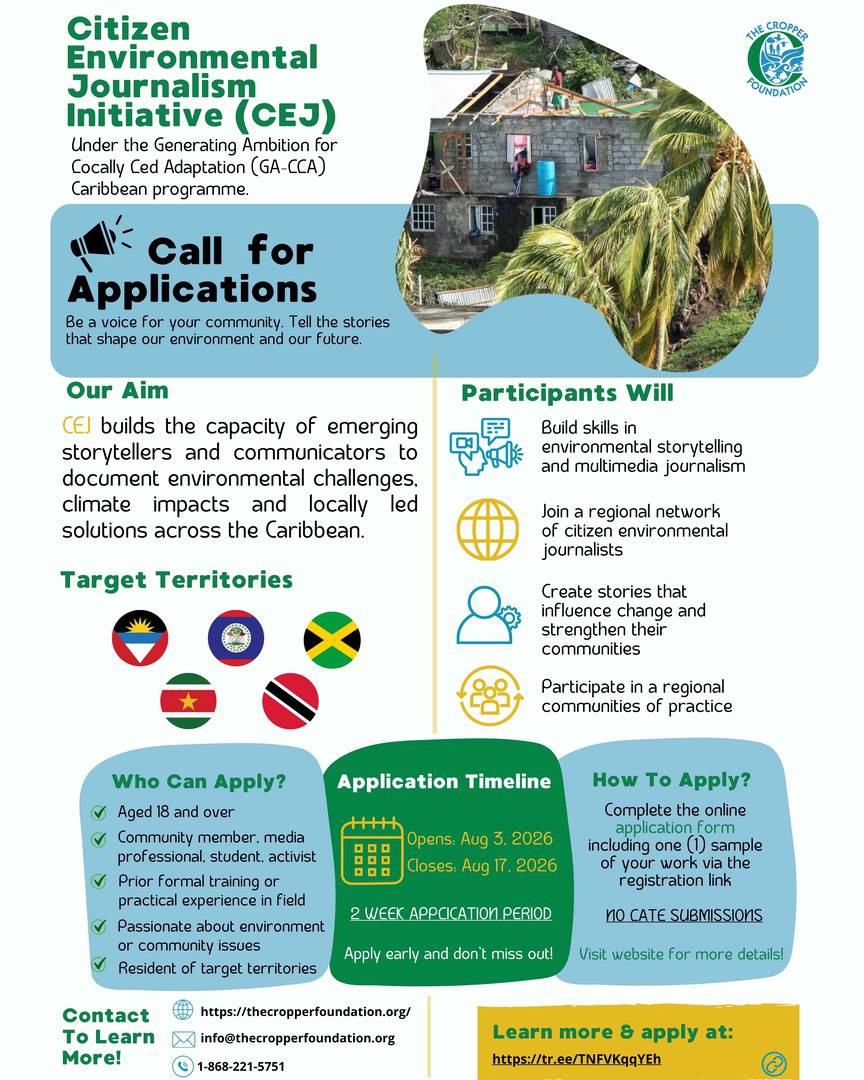
The Citizen Environmental Journalism (CEJ) initiative is a regional project led by The Cropper Foundation under the Generating Ambition for Locally Led Adaptation (GA-LLA) in the Caribbean programme. Operating across Antigua and Barbuda, Belize, Jamaica, Suriname, and Trinidad and Tobago, the initiative seeks to strengthen the visibility, understanding, and influence of locally led adaptation (LLA) by supporting community-based storytelling and environmental journalism.
Locally Led Adaptation is an approach that empowers communities to take a leading role in addressing climate change impacts. By placing local knowledge, priorities, and decision-making at the centre of adaptation efforts, LLA helps ensure that climate solutions are relevant, inclusive, and responsive to community needs. Learn More: Introduction to locally led adaptation | International Institute for Environment and Development
Through training, mentorship, collaboration, and multimedia storytelling, CEJ empowers citizen journalists and community storytellers to document climate impacts, community resilience, and locally led solutions that are often overlooked in mainstream narratives and policy discussions.
Find out how you can be part of the cohort of CEJ storytellers here!
Background and Challenges
Communities across the Caribbean are on the frontlines of climate change. From coastal erosion and flooding to water insecurity and ecosystem degradation, many communities are already implementing locally led adaptation solutions to strengthen resilience and protect livelihoods.
Despite the growing number of community-driven adaptation efforts, many of these experiences remain undocumented, underrepresented, or inaccessible to wider audiences. As a result, valuable local knowledge, lessons learned, and evidence of adaptation action are often absent from public discourse, policy conversations, and climate financing discussions.
At the same time, many community actors and emerging storytellers lack access to the skills, networks, and platforms needed to effectively communicate environmental and climate issues.
The CEJ Initiative responds to these challenges by building regional capacity for environmental storytelling and creating opportunities for community voices to contribute to climate action, advocacy, and decision-making processes.
Our Approach
The CEJ Initiative combines capacity building, mentorship, peer learning, and multimedia storytelling to create a regional network of citizen journalists and community storytellers.
Participants receive training in environmental journalism, climate communication, storytelling, multimedia production, and ethical reporting while engaging in a Community of Practice that supports collaboration, learning, and knowledge exchange across countries.
Stories and knowledge products developed through the initiative will be shared through the Cari-Bois Environmental News Network and other partner platforms to increase awareness of locally led adaptation and community resilience efforts throughout the Caribbean.
Goal
To strengthen the visibility and influence of locally led adaptation across five Caribbean countries by building a regional network of citizen journalists and community storytellers who can document, communicate, and advocate for community-driven climate action.
Objectives
The initiative aims to:
- Strengthen the capacity of citizen journalists and community storytellers to communicate environmental and climate issues;
- Increase public awareness of locally led adaptation and community resilience initiatives;
- Amplify community voices and local knowledge within climate and development discussions;
- Foster regional collaboration and knowledge exchange among environmental storytellers;
- Generate compelling evidence and stories that support climate advocacy and informed decision-making.
Expected Outcomes
By 2028, the initiative is expected to:
- Train and support 12–18 citizen journalists and community storytellers across five Caribbean countries;
- Produce at least 60 multimedia stories highlighting locally led adaptation initiatives;
- Establish a regional Community of Practice for environmental storytelling and peer learning;
- Increase the visibility of community-driven adaptation efforts in public, policy, and climate finance discussions.
Key Activities
Mapping and Story Identification: Identify locally led adaptation initiatives, community champions, and storytelling opportunities across participating countries.
Capacity Building: Deliver training in environmental journalism, climate adaptation reporting, storytelling, multimedia production, and ethical communication.
Community of Practice: Facilitate mentorship, peer learning, story development, and regional knowledge exchange among participants.
Content Production: Support the creation of articles, interviews, podcasts, photo essays, videos, and documentary content that showcase adaptation in action.
Knowledge Sharing and Advocacy: Disseminate stories and knowledge products through regional platforms while contributing community perspectives to climate dialogue, advocacy, and policy engagement processes.
Key Stakeholders
The CEJ Initiative engages a diverse network of stakeholders, including:
- Citizen journalists and community storytellers;
- Community-based organisations and civil society organisations;
- Youth groups and youth leaders;
- Indigenous and local community representatives;
- Environmental and climate practitioners;
- Media professionals and communication specialists;
- Educational institutions and researchers;
- Regional adaptation and development partners; and
- Policymakers and decision-makers involved in climate resilience and sustainable development.
GET INVOLVED
Interested in becoming a citizen environmental journalist or partnering with the initiative?
Contact us to learn more about the programme and how you can support it:
The Cropper Foundation
Email: [email protected] Tel: 1-868-221-5751